Melody Maker · 22 November 1986
Our Brilliant Career
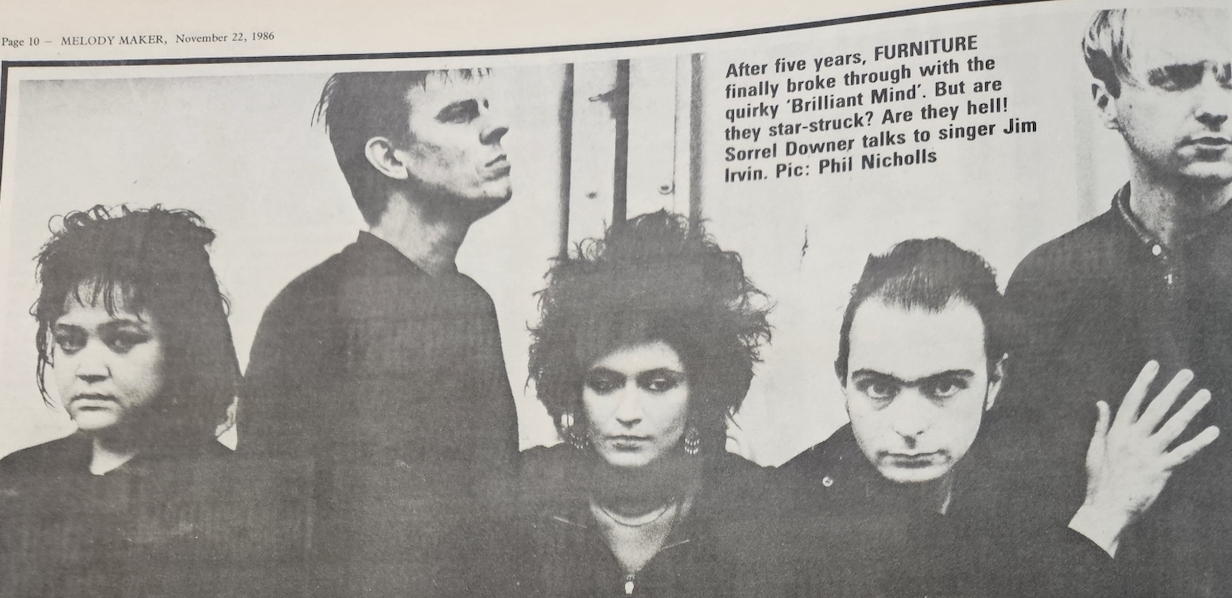
FRIDAY night. The BBC Cymru studios and Furniture stand yawning in a mute-screened, round-tabled beige room. "This is bizarre," says Jim Irvin. "This has got nothing to do with what we want to do. Why are we here?"
A rhetorical question, of course. Next day there's the "Orange Box Radio Show" ("J-J-Jaffa Box") broadcast to Wales and the mid-west. They're going to be introduced with the words "And we've got Furniture — a couple of chairs and a bedroom suite Ha Ha" by a BBC yellowcoat, and play five songs to a studio audience specialising in well-rehearsed screams.
Yes, they say, it was a bit frustrating sitting round waiting for some record company to realise that "Brilliant Mind" was a brilliant song. And yes, they would prefer the music to speak for itself, but you can't just leave it at that because you need a lot of hype and lots of people to do deals. Then Jim says that songs about emotional traumas are based on emotional traumas, and off they'll go to get some pan stick slapped on their faces.
Furniture's album, "The Wrong People", is something of a monument to mournful resignation… "What's wrong with that?" queries Jim, the singer. "My mum and dad have 'Love Letters' by Kitty Lester and it's the most perfect record with the simplest words and it made me cry. I thought, Christ! if a record can do that — that's the stuff. Everybody's cried to 'You've Lost That Loving Feeling.' Tom Waits' 'Kentucky Avenue' made me cry and Ella Fitzgerald's 'Every Time We Say Goodbye' made me cry…
"Lamont Dozier rang up a girlfriend once and started telling her he'd been seeing someone else. She went 'In the name of love, stop!' and the bastard wrote it down. He used to say whenever he was short of material he'd ring up his latest girlfriend." Frightening, but I can see his point.
Happiness can be a bit of a handicap when you trade in nostalgia: "I had a relationship that was really deep for me — the nearest to real love I've ever felt, where you're walking on air — and I almost felt like giving up music because I was so content."
Does he find himself drawn to relationships that are more interesting than comforting?
"Oh yes. I remember I'd been seeing someone for about three weeks when she said 'You're too nice, I want to go out with a bastard' and I can see that now. I find myself drawn to a sort of femme fatale. Someone that's going to wind me up a bit."
But doesn't he have any qualms about being quite so public about private life?
"If someone's gone off and left you, they're not bothered, and I'm not bothered. What's an entertainer for? Some people wanted Jim Morrison to live his life on the edge for them. Some people want Morrissey to sing about strange, spotty, sexless relationships, and some people need someone to sing about lost love for them."
And that's Furniture's role?
"That's our role this week. All we do is just try to be true."
But most logical, to Jim, are the stringent restrictions of critical response.
"I listen to all sorts of music, everyone I know does. Different styles for different moods, and I treat writing songs in the same way as I treat listening to them. But people can't accept that. We got people asking for their money back at Leatherhead and you think what do they want us to do? 'Brilliant Mind' a dozen times?
"On the album, the songs go from 'Pierre's Fight' with weird out of time drumming, just a piano and a voice, to 'Sound Of The Bell' with its urgent choppy feel, to something more reflective, slower like 'Miss You', and it's odd that no-one gives you the luxury to do that.
"There's too many pop songs that depend on clichés and I don't need to use them, though I'm not going the other way, doing a Lloyd Cole and rhyming I love your hair with Baudelaire.
"All I'm trying to do is be eloquent within the medium I've chosen but they won't allow me the luxury of using words properly.
"You're having to justify your existence almost every minute of the day. The pop business expects you to take a lot of crap. You're doing these interviews, TVs, photo sessions all over the place and they still expect you to be lucid, polite and jolly. And if the thing that motivated you wasn't the jolliness in the first place, that's fucking hard to do.
"'Brilliant Mind' was about confusion and dissatisfaction with what your life represents and what it is you're working towards. Though it was written two-and-a-half years ago, it still holds true — in fact it got more and more relevant as the tour went on, and you come to realise that this thing you've worked toward all your life is crap. Being in the pop business is rotten."